Friday, April 17, 2009

A Thought Journey

Casual readers of this blog will notice the random themes, introspection, and commentary on events in business and finance. I have decided to channel this, but hopefully in a more meaningful way, into a series of essays. The themes are broad and the ideas random. This fits my personality and allows me to reflect and create. By posting this, I commit myself publicly to this work: a short book of essays.

That said, I will use this site to diffuse any finance-related theme I include in my writings. A note of warning or of jubilee: postings going forward will be more sporadic and less frequent than the past. Below is what I have so far. I'm halfway done with two of the essays. I welcome your comments and ideas.

Education:

i) Why I Write

ii) Types of Books

iii) Education

iv) Cultural Observations

Places:

v) The Real Mexico

vi) The Farm

People:

vii) Mr. Buffett

Misc:

viii) On Investing

ix) My Experience at Goldman Sachs

x) Our Sacred Stuff

xi) Running

xii) Skiing & Golf

xiii) The Buy Recommendation

Tuesday, April 14, 2009

Fees

Ebay's exit from the Skype debacle is a boon for financial helpers: fees for buying and then fees for divesting. Ain't life grand. It's not that advisers don't always earn their keep. But there are definitely misaligned incentives, when, from their perspective, the payout is: deal closes, big payout; deal fails, little money. Unless of course, you advise on both the acquisition and the divestiture. But I'd hope Ebay would have more sense than using the same helpers twice.

Sunday, April 12, 2009

One Question

From its humble beginnings decades ago, Berkshire's annual meeting has morphed into a series of events known as the Woodstock for Capitalists. Rental car prices for that weekend attest to the popularity of the meeting; I can't find a car for less than $50.00 per day.

That said, this year's annual meeting offers a huge improvement over past years: the Q&A format will be half questions pre-screened by three journalists, and half awarded by drawing. Previous years were plagued with disputes about the ethics of hydroelectric dams and the conflict in Darfur (two important issues but not worthy of so much mic time in this type of setting).

And so, I offer my question, which I've emailed to one of the journalists mentioned in the 2008 shareholders' letter.


Messrs. Buffett and Munger:

Berkshire in the past has bought and sold interests in public companies. Could you comment on the orthodoxy of the till-judgment-day-do-us-part philosophy of Berkshire's operating companies?


Disclosure:
None

Monday, April 6, 2009

Credit-Default Swaps

If there's been one benefit of the financial crisis, it's the improvement in financial literacy. People are now paying attention to ratings, interest rates, and Fedspeak. Even credit-default swaps, at whatever level of understanding , are fair game for dinner-time conversation.

The recession has even brought into question the bedrock of finance theory: efficient markets, or the idea that market prices reflect all available information. One professor at the Solvay Brussels School of Economics confesses that the CDS market is "opaque, often illiquid, and prone to manipulation." This leads to share price pressure and a bundle of screwy signals to both rating agencies and short sellers. Alas, the markets are mostly efficient, and certain anomalies are worth exploiting. Just don't try to argue with your business school professor about this.

Tuesday, March 31, 2009

Oh the joys of TARP

The shotgun marriage between banks and government appears to be having some unintended consequences. While some firms, Goldman in particular, have talked about returning bailout cash, Washington has stalled such attempts saying it's not ready to get its money back. Weird.

Experiences financiers are now seeing today as a great time to jump ship. Punitive tax rates on already-distributed bonuses, further regulatory scrutiny, and a more risk averse balance sheet must have an effect on the most experienced bankers willingness to go to work in the morning.

Goldman offers a great example. Recently, Jon Winkleried, one of the top-3 at GS, decided to retire. Byron Trott, the rare banker (if not the only) to receive praise from Warren Buffett, is leaving to start his own merchant banking firm. And the co-heads of Global Alpha, Goldman's flagship hedge fund, are retiring to pursue other interests.

They'll be glad to be away from TARP.

Tuesday, March 24, 2009

AmEx: Reasonably Priced Plastic

The below is posted with a one day lag. (it was part of the application process for a freelance/contract writer position).

American Express

To participants of the capitalistic system American Express (“AmEx”) needs little introduction. The firm is a global payments, credit card, and travel company whose products are catered to well-heeled clients. AmEx runs one of the most prominent credit card networks in the world; unlike its largest rivals Visa and Mastercard, however, it profits from the entire economic cycle of issuing the card, swiping the plastic (via the merchant fees), other fees, and the spread on loans it provides. It is an economic powerhouse but is subject to greater volatility because of its risks of operating such a full cycle network.

As a somewhat mature company it “has sought to return at least 65% of the capital it generates to shareholders as a dividend or through the repurchase of common stock,” a goal it has since tempered as a result of the strings attached with money it has taken from Uncle Sam. A more muted target, though impressive nonetheless, of 20% return on equity, is now the company’s goal on account of higher charge-off rates and higher capital requirements.

In 2008 the company grew revenue 3% year-over-year to the impressive sum of $28 billion. This is possible through its boastful network of 92.4 million cards, an industry leading high-FICO-score client base, and ultra-low costs of funds of 3.63% for long-term debt and 2.11% for short-term borrowings.

My unofficial mentor, Warren Buffett—through Berkshire Hathaway—has maintained his position as the largest shareholder. That’s not to say the stock is without risk. A few of AmEx’s risks and uncertainties include: legislation on interest rates would adversely affect the company’s spread (interest charged vs. cost of funds); a really-bad-case-scenario in the macro environment would result in an even bigger spike in the charge-off rate (currently at 8.7%); a longer-than-expected turnaround in the securitization market would force liquidity issues.


Furthermore, at 407 pages, the 2008 10K is long enough to discourage even the most determined annual report aficionados. But the audit report looks clean and the numbers don’t look funny.

Valuation
So what is AmEx worth? Cash flow from operations has historically been 2-3x net income, largely due to the non-cash charge for the provision for losses. I use the more conservative net income as a base. The economy is in “shambles” as Buffett has stated, and a greater portion of the world’s citizens may continue their indifference towards paying their bills. Earnings multiples should be applied with caution since these are truly extraordinary times. Even with a 50% haircut off of last year’s net income, the stock trades at close to 12x earnings, or an 8% adjusted earnings yield (the inverse of P/E ratio)—it currently has a 5.9% dividend yield while paying out only 1/3 of earnings. This is a conservatively adjusted value and reflects the erosion of securitization income ($1bn in 2008) and a marked increase in the charge-off rate.

The Bottom Line
American Express has inched its way up to the 11th spot in CoreBrand’s brand ranking survey of 2008 and is 15th in BusinessWeek’s 2007 ranking. Translation to the card user: If you get charged $1000.00 for a breakfast at a cafĂ© in Peru, you can trust that AmEx will fight to reverse the charges. It is the antithesis of the IRS. That business moat is hard to replicate. The company is positioned to profit from the long-term demographic trend towards a cashless society. That said, the brand value, and the attractive adjusted earnings multiple, provide an adequate margin of safety. I rate American Express a “buy.”


-----------------------
P.S. 500 words (about the length of this piece) is a very short space to try to describe and dissect a business.

Disclosure:
The author has an AmEx card but pays off the balance every month. He also owns shares of AXP.

Sunday, March 15, 2009

Performance Update

All stock-related sites should report an unbiased scorecard. The Faro portfolio puts itself up against the same test. The fund inception date correlates with the launch of this humble blog--estimates are in that there are 4-5 regular readers. The inception date is Oct 2007. If I had tried to "time" the start of such an auspicious task, well, I'm really bad at timing: stocks have lost half their value since then.

I still believe the case for stock investing stands. The transaction costs are almost nil (tell that to your real estate broker); they allow you to become part owners in pieces of potentially great businesses; owning strong companies over time is a great buffer to the loss of purchasing power (if the business can raise it's prices with inflation, it's returns should rise with general prices); historically, the returns for any one with a long-term horizon better any other asset class.

Since inception, the portfolio is down -17.8% vs. -49.40% for the S&P. It's worse than under you mattress but much better than most mutual funds.


--------------------------------
Full Disclosure: none

Sunday, March 8, 2009

Company of the week

30 years ago, out of the wreckage of an imploding company, Leucadia National Corp (Ticker: LUK) was born. Ian Cumming and Joseph Steinberg have since transformed the firm from its early days of a shareholders' equity deficit of -7.7mn to +2.7bn. Albert Einstein's reverence of the miracle of compound interest has been at work: a $1,000 dollar investment in 1978 would be worth 1.98mn as of 12/31/08; that's a 28% annualized return. Book value has grown at a slightly more impressive rate.

The recent past has been less than stellar. From its zenith in May 2008 to Friday's market close price, the per share value has dropped 80% while the S&P 500 has declined 52%.

The source of the underperformance has to do with the nature of Leucadia. From the 10k we read: "In identifying possible acquisitions, the Company tends to seek assets and companies that are out of favor or troubled and, as a result, are selling substantially below the values the Company believes to be present.(1)" Unloved companies tend to underperform in spurts. By definition they have problems that others would rather avoid.

The company is a hodge podge of subsidiaries involved in timber, plastics, telecommunications, real estate, medical product development, wineries and others. The firm also owns a sizeable portfolio of publicly traded stocks ranging from mining, auto finance, Argentine agriculture, to Jeffries: an investment bank. In addition, Leucadia owns limited partnership interests in several asset management firms.

I'm still trying to grasp the estimated worth of the the company many call a "mini Berkshire." With such diverse companies, capital needs, and volatility of certain assets, estimated intrinsic value cannot be conveyed in a short blog post. But at a discount to book value, and with such an impressive track record and philosophy I mostly agree with, I decided a dip in the pool was worth it, even when I wasn't certain of crocs or the exact water temperature.

--------------------------------

Full Disclosure:
The author recently purchased a few shares of Leucadia. He also has a job interview with the company this Thursday.

Notes:
(1) 2008 form 10k

Saturday, February 28, 2009

Buffett looks ahead after lousy year.

The much anticipated 2008 year-end Berkshire Hathaway Shareholders’ letter was released today. Buffett’s words are followed both for information on the direction of the conglomerate (highly weighted in insurance and utilities), as well as his thoughts and criticism of both business and politics.


It’s tone, wit, and substance is eaten up by media outlets. Stories are released within two hours after digesting the 20 page later. The headlines, of course, say a lot about how his words are interpreted, what the company’s results mean, and how this bodes for the economy as a whole.


So, I present to you how the most highly-regarded media sources and their spin on what he said. This does not substitute actually reading it, something I would encourage to anyone who either owns stocks or cares about politics or economics.


Here they are:


AP: Berkshire reports a 96 percent drop in 4Q profit

NYT: In Letter, Buffett Is Frank but Optimistic

WSJ: Berkshire Reports Worst Year Ever

Bloomberg 1: Buffett Says U.S. Economy Will Be `Shambles' in 2009, Likely `Well Beyond'

Bloomberg 2: Berkshire Profit Plunges 96% as Buffett Writes Down Derivatives Positions

Reuters: Berkshire net sinks; Buffett says economy in shambles

FT: Buffett’s Berkshire has worst results ever


I would have to cast my vote for the New York Times article, both for the headline and for its content.

As a Buffett devotee, I copied quotes and have lumped them together in this little collage:


America’s best days lie ahead…economy will

be in shambles throughout 2009 – and, for that matter, probably well beyond…

Home purchases should involve an honest-to-God down payment

of at least 10% and monthly payments that can be comfortably handled by the borrower’s income. That income should be carefully verified... The investment world has gone from underpricing risk to overpricing it…The U.S. Treasury bond bubble of late 2008 may be regarded as almost equally extraordinary.”


What does this mean? The last two parts of the quotes are crucial for the individual investor. Buffett is predicting inflation; Bernanke is a scholar of the Great Depression and knows the perils of deflation. Inflation is currently not on the market’s mind, but as money is injected into the system prices and interest rates will rise—a death blow to bonds (prices and interest rates are inversely correlated). But, short-term bonds (little interest rate risk) in high quality corporations will do well—the “overpricing” of risk that he mentions means that some bonds are cheap. That’s why he’s pounced on fixed income in GE, Wrigley, Goldman, Harley Davidson, Tiffany, and others.


We’d be smart to look for similar bargains in high-quality companies’ debt.


JA


Thursday, February 26, 2009

What to do with extra cash

The Economist has a great piece on the dilemma of today's prudent savers. It's hard to get excited about 1-2% yields on online savings accounts. And 5-yr treasuries yield only 2%.

There is hope in one end of the capital structure. High-grade corporate bonds that mature in the next 2-4 years offer compelling prospects (longer-term bonds have greater duration and therefore greater interest rate risk--think about possible medium-term inflation as we sell treasuries to Asia.) Spreads now are 400-600+ basis points above treasuries. Now, of course, this reflects perceived and actual risk, but with a little review of the underlying company's balance sheets and off-balance sheet stuff, you'll be rewarded by more than a few pennies.

Here are a few (non-callable bonds) worth considering as an alternative to idle cash:


Company | Rating | Maturity | Price | Coupon | Yield to Maturity | Current Yield

Alcoa BBB Jan/2012 87.88 6% 11.00% 6.83%

Kohls BBB Oct/2011 105.69 7.4% 5.02% 6.98%

Goldman A Feb/2012 99.30 5.3% 5.56% 5.4%

Monday, February 23, 2009

Nordies Reports

Prized by shopaholics and loathed by penny pinching husbands, today after market close, Nordstrom (JWN) reports 4th quarter financial results.

Two days ago, intra-day volume for 10.00 March put options spiked to 1,368 contracts (representing 1.37 million shares, or less than 1% of float); calls of the same strike price only attracted 2 contracts. Betting on short-term momentum has never appealed to my personal investment philosophy. Though JWN’s intrinsic value won’t change much regardless of whether the retailer misses by a penny, traders feel it’s worth betting that the earnings release will disappoint.

Amazingly, during the dotcom bubble, same store sales dropped only 1%. During our current market malaise, however, same store sales have fallen over 12%. There is a price at which I’d love to own such a great brand—the stock is 70% cheaper than the 52-week high. But given the economic headwind, I still wouldn’t now bet on $200.00 jeans.

I’d like to see management cut back on capital expenditures which have eaten into cash flow over the last year. The company should slice its 4.6% dividend yield in half, saving the Seattle-based retailer $70mn per year, which it could use to help trim down the $2.74bn in long-term debt (2x EBITDA).

Sunday, February 22, 2009

A note


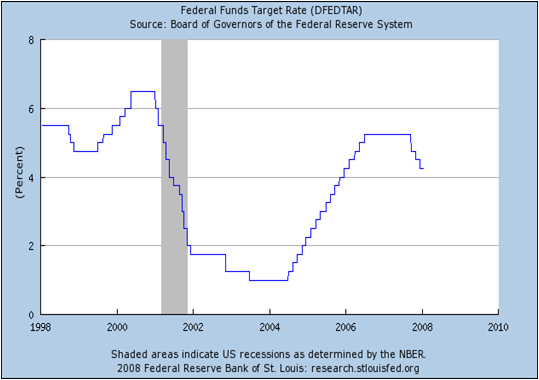
In a previous post on how the housing bubble grew, I mentioned two potential guilty parties: banks and individuals. I should have added the role of government to the equation. Uncle Sam was complicit through its drastic loosening of the fed funds rate in the post-dotcom bubble. The government, through friends Fannie and Freddie, also encouraged insane lending and scooped up over half the mortgages originated.

This will be written in history as one of the more memorable unintended consequences of government intervention.


Image source: http://www.princeton.edu/~pkrugman/fed-funds-rate.png

Wednesday, February 11, 2009

Baby Formula and Special Dividends

If you have children you've complained about the cost of baby formula. Today a baby formula maker had an IPO whose success is built on pricey fake mother's milk. Mead Johnson (MJN), leader in the pediatric nutrition market, sold 30M of 200M shares outstanding. Proceeds from the offering, a carve-out from Brisol-Myers Squibb (BMY), valued the company at over $4.8B.

It appears to be reasonably valued. The company is selling for 1.7x revenue, 10x earnings, has grown sales at 5-10% even in challenging economic times, and boasts of a 22% operating margin.

Now to the obligatory "use of proceeds" section. The $600M in net value the company received from the IPO will go to pay an inter-company note. However, $1.4B will still be left in debt since the parent company, surely through the advice of a strategic adviser, decided to "lever" MJN with $2B in debt prior to the carve-out. Not that this isn't manageable given Mead Johnson's level of profitability, but to put the stockholders' equity at a deficit of $800M to line the wallets of Bristol-Myers Squibb is wrong. BMS will use the $2B to pay a special dividend. That ain't so special a way for Mead to start as a public company, even if it can rest on high-priced milk.

Sunday, February 8, 2009

On housing, lending, and advice for my grandkids

As all writers of anything finance-related, I feel compelled to comment on housing’s role in our current economic crisis and end with the clichĂ©d "lessons learned" bit.

It’s tempting to say we all foresaw this. There is no doubt that housing was and is a critical part of our deep economic malaise. The seeds were sewn through low interests rates, poor lending practices, and the cultural notion that a house is more than just a roof over one's head. Though it can be more, speculative short-term gains in residential real estate should never drive a rational person’s decisions.

On the housing bubble, there are two predominate ideological camps: 1) it's the banks' fault; 2) it's the home buyers’ fault.

The first group feels the home buyers were unsuspecting victims, preyed upon by Mr. Burns-type lenders: greedy, cold, and with a profit-only code of ethics. (Not all bankers are like this, but it makes for good imagery). These bankers were eager to rush loan approvals to hasten the securitization process whereby ensuring private school tuition, vacations in Bora Bora, and early retirement. Bankers should be punished, regulated, and striped of the compensation that Croesus himself would envy.

Banks are greedy. Their fees are high, and certain aspects of their businesses need to be regulated (OTC options come to mind). But they do, however, provide a valuable service to the economy. Credit drives our economy. Anyone who’s been granted a loan will attest to that.

The other group believes the home buyers themselves are to blame. Stories of credit-less deadbeats buying multiple houses with the idea of flipping and becoming wealthy, draw the ire of penny pinchers. These reckless borrowers collectively failed to notice the bubble-level home price to median income (the PE ratio of homes) ratio. Somewhere down the road, it would have to correct. They deserved their prize; they too were greedy. The modern corporation does not hold a monopoly on unethical behavior. After all, this is capitalism, and individualism rules.

To mend the housing and credit problems there are no easy solutions. I have no idea which items of the current "stimulus bill" will have the greatest multiplier effect. I only hope that government behaves better than in times past.

Understanding this, however, isn’t the real issue from a personal learning point of view. Financial manias and asset bubbles will reappear. They are “Black Swan” events.

The real value in having lived through 2008 (and beyond) is not learning how we can personally predict (and prophetically time) any future crises, but to examine it from the most micro of human levels. What do these events tell me about how I should shape my behavior and views?

At the risk of being too prescriptive, something that I loath about most business books, I offer advice to my children and future grandchildren.

In anything in life, if there are no significant barriers to entry, it's not worth doing. Medicine requires smarts and time. Athletics begs time and talent. Business demands good ideas, execution, and drive. Anyone could set up a mortgage brokerage business and undercut the professional and legitimate players through lackadaisical lending standards. The barrier to doing it right is ethics, work, and patience. Most don’t have all three.

Lastly, (and not that there are only two, but because two are easier to remember) the further you separate the risk taker from the actual risk bearer, the more likely you are to face an unsavory result. A father, through no intermediary, should know and trust his future son-in-law. Bankers should know and trust borrowers.

Sunday, January 25, 2009

Some thoughts on business analysis and macro forecasts.


Posting stock picks creates the obvious pressure: be right and you'll look smart; if you're wrong your sins are on display for all to see. Most either shy away from this or bombard the reader with innumerable "buys" so that it becomes impractical to work through the math to find out how valuable the advice really is.

Naturally, the reader must be weary of either of the two extremes. Outside politics, and in most environments where discussion of the stock market is heated, failure to take a definitive position shows lack of confidence, and an unwillingness to (justifiably) allow others' to criticize your ideas. Being overly sanguine about every idea, on the other hand, is reckless and dishonest.

Thus the logical responses when a stocks attractiveness is considered are: 1) I don't know, 2) It's probably a bad idea, and there are myriad reasons for this: it's too complicated; the business is lousy ; management is inept; My brother-in-law knows I guy who's an insider and he says it's going up. And finally, 3) It's worth owning, usually because the numbers look good and the business is solid--note the nebulous terms "good" and "solid"; I'm being purposefully vague since not all attractively priced stocks are a "buy" for the same reason. But, intrinsic business value rarely changes as much as many of the daily prices quotes would indicate, especially during market malaise.

These three answers may seem painfully simple. In a world of huge egos and image management, however, most are afraid to look like dummies and therefore feel obligated to have a strong opinion about every investment issue. "Oh oil, yeah, it's going up; there's just so much pent up demand." This is a monumental error. I turn to my unofficial and dead mentor Abe Lincoln for a quote that fits nicely with this fallacy: “Better to remain silent and be thought a fool than to speak out and remove all doubt.”

The cure for this vice is to embrace the 50th percentile. Just be average with some things. My answer is, I don't know where oil prices will be in six months. Please understand, however, that references to this are short-term forecasts. One can assume that certain long-term imbalances will lead to glaring macroeconomic consequences (e.g., America's entitlement programs). Also, there are some great macro-economists. But given my understanding of history, very, very few get both the timing and the event correct.

That is why I choose to be a business analyst and not an economist. And so, I move forward boldly, with the philosophy that good ideas are rare, simple, and should be put up to the scrutiny of the economics of the business against the market's perception. I publish ideas knowing what's on the line with the hope I'm right more often than not.

Sunday, December 21, 2008

What's the most meaningful way to measure investment returns?


It's being called the biggest investment scam ever. The Economist suggested, partly tongue-in-cheek, that the "Ponzi" scheme be rebranded the "Madoff" scheme due to its size and scope. Newspapers and blogs are humming about the institutions and country club members who fell for Bernie's years of lies. Obviously, especially in retrospect, the flags were crimson. A three-person audit firm was one. The supposedly consistent 10-12% annualized returns was perhaps the biggest; the open interest in the S&P 100 options used to run the split-strike strategy was too low to support $17B of activity.

Even if the volume of options wasn't a deal killer, how would you further critique the steady investment results? This is a problem the investment management business has yet to solve, or at least speak honestly about. What's the most meaningful way to measure investment returns?

Leverage and luck are two culprits. Pile on loads of debt either through margin or options and if things go your way, your returns are juiced. If you're wrong, your bad returns are amplified. Luck can be indistinguishable from skill in the short-term. So track records should count for something.

Naturally, hedge funds and other investment vehicles breed opacity. If they divulged everything than others would simple mimic their strategies and trades and therefore "crowd out" that corner of the investment world and dry up the excess returns. But investors now will demand greater transparency, or at least know that such a way of making money is feasible.

Oddly, most investment managers treat the quality of the return as ancillary--quality in the sense of risk and in probable future results. Since their incentives are to make the coveted 2/20 fees, high risk and high returns go hand in hand. Their traditional tools of return calculation use either beta (the covariance between the asset return and the market return) or the standard deviation of the portfolio, in some relation to returns generated. Again, they're not clear as to how the returns were made, only the final number. They also use a flawed definition of risk, but that's worthy of a separate posting.

Unlevered (equity only), market beating, long-term transparent strategies are the best way to measure investment returns; the final return measured against last year's price movement deviations is not enough. It's fair to ask how a manager justifies his fees and the scorecard that should be used to decide whether he should still have a job. Managers owe their clients restful sleep.

For a group that demands, clarity, loose regulations, detailed financial footnotes, and management candor, the investment management industry needs to come clean on how it measures returns. It would help doctors, teachers, and janitors to know that not everyone that manages money is like Bernie Madoff; some of them actually "add value."

------------
Disclosure: none
Image: http://www.yu.edu/uploadedImages/Sy_Syms/Dinner_2008/madoff_web.jpg

Wednesday, November 26, 2008

A Carnival Quiz


I easily get excited about new businesses and what makes them tick. The industry on my mind over the last several days has been the cruise industry. And after having recently finished my first cruise, I thought this little cruise quiz would be a fun test of your cruise business intuition. Questions of this sort were on my mind between meals and while relaxing by the pool. Enjoy. Answers are posted at the end.


1. Which of the following cruise company does Carnival not own?

A) Princess
B) Holland America
C) Celebrity
D) Seaborn

2. The percentage of worldwide cruise passengers sourced from North America is....

A) 40%
B) 50%
C) 60%
D) 70%

3. Cruises have the well-deserved reputation as places to overeat. What percentage of total passenger ticket sales does Carnival spend of food for its chubby guests?

A) 8%
B) 16%
C) 24%
D) 31%


4. A great (and consistent) source of revenue is derived from other income (alcohol, casinos, souvenirs, land excursions, photos, etc.) True or false, this makes up 50% of total revenue?


5. ALBD means what in cruise economics?


6. Carnival and its publicly-traded rival Royal Caribbean have sales/debt ratios of:

A) between 20% and 49%
B) between 50% and 60%
C) between 61% and 90%
D) greater than 100%


7. What corporate action did the industry's cruise operators recently announce?


A) A near-term discontinuance of stock dividends
B) A huge drop in asset-backed securitizations
C) An increase in the share repurchase program
D) A move in corporate offices from Spokane to Atlanta.


Answer Key: 1) A, 2) D, 3) B, 4) False. It's closer to 25% of sales. 5) Costs per available lower berth day "ALBD". ALBDs assume that each cabin offered for sale accommodates two passengers and is computed by multiplying passenger capacity by revenue-producing ship operating days in the period. 6) C, 7) A.

Friday, November 7, 2008

A few words on public vs. private


After balance sheet concerns and the overall lackluster macro economic environment, the decision to be a public or private company must now keep executives wondering. Is it worth it to be a pubic company?

Most public companies have a culture of benchmarking and short-sided metrics. They are faced with quarterly grillings at the hands of mostly out-of-touch analysts who are more concerned about modeling next quarter's capital expenditures and whether earnings are off by a penny. I'm not just being cynical either. If you've listened to quarterly calls you get my point. Though some notable CEOs have the mettle to withstand the institutional imperative, most do not. A study by McKinsey & Co. shows that 50% of execs would forgo a positive NPV project rather than miss next quarter's numbers. My guess is if all were truthful it'd be even higher.

Public companies almost universally decide to grant top employees stock options. However, though these carry a tax benefit, the compliance savings of not having to abide by Sarbanes-Oxley (private co's don't have to follow this), would more than offset the tax advantage for most companies. An alternative to public stock options: a combination of cash incentives and private stock offerings. The only issue is they can't bail and sell with the ease of the the public markets. But who wants a short-term marriage anyway?

I would prefer to own a private business. I don't need to know my net worth every day. I'm in it for the long haul and I'd rather sacrifice next year's numbers for a long-term strategy that makes sense. If you're a company that needs constant access to the capital markets, a daily performace scorecard, and thinks high doses of liquid shares should be granted to top talent, stick with the public model. As for me, I prefer my privacy.

-------------------------
Disclosure: I still think some public companies are awesome.
Image: http://act.psy.cmu.edu/awpt/pictures/graph.gif

Sunday, October 26, 2008

The Covered Call


The credit bubble has made fools out of many people. Economists assumed housing prices couldn't systematically drop. Banks didn't care about the underlying credit worthiness of the home owners since they quickly repackaged the loans and sold them to Fannie, Freddie, or Bear Stearns. Economics has lived up to its reputation of being a backward looking study whose predictive ability stinks. Financial risk cannot be measured based on distributions of historical returns since history does not repeat itself. This time is, and will continue to be different than '29, '73, '87, or '01. Stockpickers, this site included, have made gutsy bets on downtrodden stocks only to see their market prices plummet further.

VIX

With the CBOE volatity index (VIX), "fear index" at all-time highs, options are steeply priced due to implied near-term volatility. A high VIX index, if you're a contrarian, is a bullish signal since markets tend to place too much emphasis on the recent past.

A short call

This particular strategy is an alternative to the 1.27% yield of a 6-month T-bill or could be a long-term investment with capped upside and limited downside. Here's the play: Find a stock whose fundamentals you aren't too afraid of. Simultaneously buy shares and sell a deep-in-the-money call option. I've selected Discover Financial, a previous long only recommendation.


DFS

Discover Financial (DFS) issues credit cards and processes payments. Charge-offs are rising but Discover has over $10B in cash, only 1.85B in debt, a mere 30M in mortgage-related securities, and $1B in loan loss provisions for those who are indifferent about poor credit records. Loans, like with American Express are securitized and are therefore off-balance-sheet. Lack of willing buyers of receivables is the most serious near-term concern. Yesterday Visa and MasterCard announced a $2.75B settlement with Discover over anti-competitive practices. That adds more of a cash cushion. This is a good business at a good price (not a great business at a fantastic price--these situations are obviously rare).

The possible payoff

A 7.50 Nov 2008 call sells for 2.55/2.95 (bid/ask). If you buy 100 shares at 9.68 + .05 per share commission and collect the 2.51 (2.55 - 4.00 commission) from the short call option you face a 74% loss if the stock goes to zero, a breakeven scenario at 7.27 and a maximum profit of 2.88% if the stock finishes above 7.50. The stock could drop a further 22% from the current price and you'd still make 2.88% (including commission). This could be compared to picking up nickles in front of a steam roller. I think the downside protection is sufficient to justify a short-term alternative for idle cash.

_____________________

Disclosure:
Faro has recently made this trade. Do this with only a small portion of your available cash. Don't get too greedy and only invest in a company whose fundamentals you believe to be sound. If I were long-only one credit card company it would be AXP (a similar covered position could be made with a slightly higher investment and a lower maximum payoff).

Image: http://blog.sellsiusrealestate.com/wp-content/credit-bubble.gif

Saturday, October 11, 2008

For Sale?


After the worst week ever for the Dow, the recent drop-off is now worthy of wikipedia. At cocktail parties and dinner tables the topic du jour is the market and the effect on investors' retirement accounts. We love to put the stock market in the simplest of terms, and in an odd retrospective view. The stock market is merely a place where businesses are bought and sold. Contrary to popular opinion, it is never universally wrong or right to buy or sell. But we should at least think about why we're buying or selling a piece of a business.


Cash flows

According to finance theory (and sometimes reality) the value of any asset is equal to the present value of all future expected cash flows. And with some stocks down 80% +, their very existence is now questioned, even without the toxic balance sheets of banks. Peak to trough the market has fallen over 46%, well into what economists consider bear market territory.


So if you have some cash on the sidelines, here's what to look for in companies and in strategies:


  • A super clean balance sheet: since credit is a huge part of the problem, debt is now a sin. We have yet to see the coming wave of corporate debt defaults. The 10%+ spread of non-investment grade debt to US Treasuries is a testament to risk and uncertainty.


  • Tiny market caps: these are thinly traded and have little or no analyst coverage; their price swings can be the biggest and their pricing the most inefficient.


  • A large cash pile: this serves as a further cushion, or margin of safety, against a greater collapse.


  • A business: a product or service that is needed or wanted in any economic environment.


  • Options: covered calls (if you'd like to lower your effective cost basis but cap your upside, consider this) or married puts (to protect the downside).


And?


Faro is finding extreme value in global mining, Brazilian poultry, and Chinese education. Timing the market bottom is a fool's errand. However, I wouldn't bet (long at least) on banks or the American consumer (70% of GDP). Shrinking retirement accounts, falling home prices, and tightened credit must eventually bring even the most spendthrift of consumers to question whether to fork out $40.00 for dinner or drop $200.00 for jeans. Though the recent plunge reflects this, the enhanced awareness may likely lead to a self-fulfilling prophesy: an even bigger drop for companies that sell stuff people only think they need.


_______________


Note: Though readers may note the poor record (along with the market) of previous stock recommendations on this site, Faro is happy to report a flat last two weeks due to a short position in a domestic retailer.

Image: http://www.biojobblog.com/for_sale_sign(1).jpg